Just because you don’t know what somebody does for a living doesn’t mean their job is worthless. One of the many side effects of the new Trump government is that DOGE, the Department of Government Efficiency, has been hard at work taking an ax to the government. There are so many salvos against the public sector that I can’t keep track of which ones are the most abhorrent, but reducing the credit card limit for federal employees to just $1 may be among the stupidest.
We have ways of measuring worker output using terms such as productivity, which is commonly defined as economic output per worker per unit of time. If a firm has 100 workers and $1,000 in revenue, the productivity per worker is $10. The math is simple. However, for government employees, the calculation of productivity changes. The function of government is not to generate revenue but to provide services. Education, infrastructure, public services, and various other government functions have payoff profiles that are difficult to quantify, yet they are incredibly essential.
So how do we measure the effectiveness of government employees if we can’t rely on profits and losses? We can use a few other metrics, including internal and external perception. When I say internal perception, I mean an internal review of the value employees add through their work. Would it surprise you to hear that 91% of government workers believe their jobs add value? I’m trying to find the article that compared the views of federal employees to those in the private sector, but the conclusion was that federal employees were more likely to believe their jobs had worth than their private-sector counterparts.
I find the divide between internal job value and external perception the most interesting. If 9 out of 10 workers believe their jobs contribute to the common good, yet barely 5 out of 10 feel their work is recognized, it highlights a major disconnect.
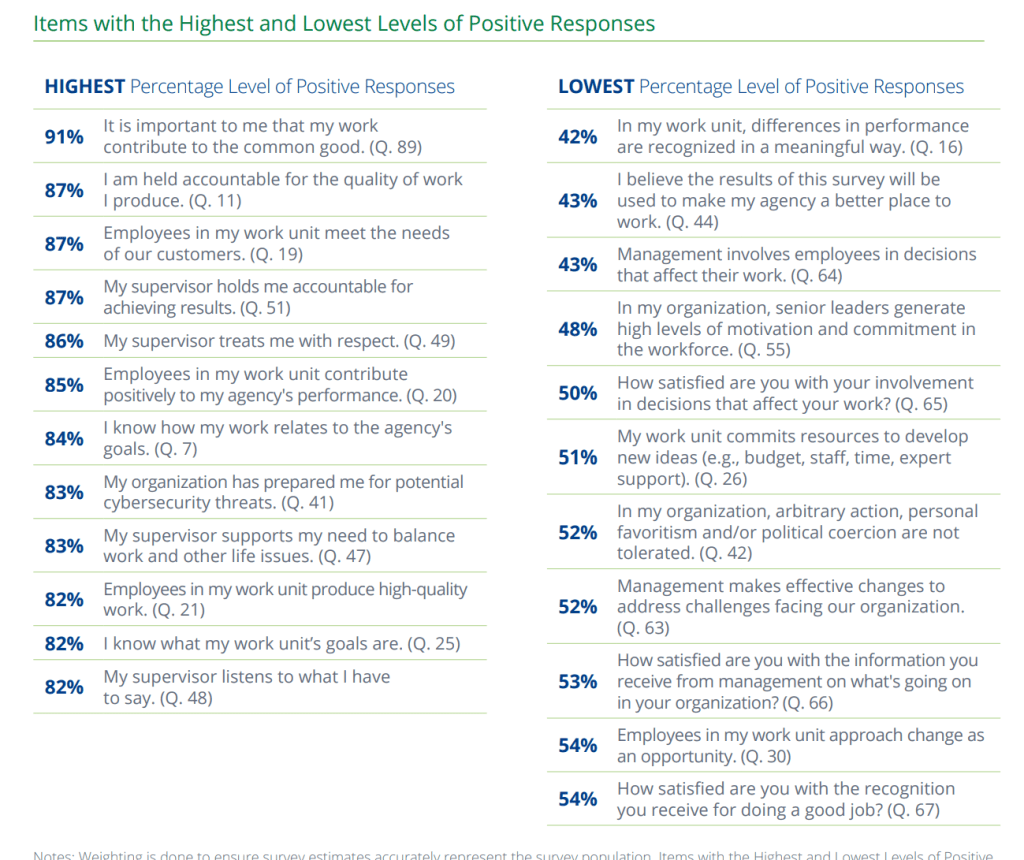
That makes things even more interesting when you take the external view into account. Fifty-six percent of citizens believe the government is wasteful, which is actually lower than I expected. So what causes this divide between how government employees perceive their own worth and how the public sees them?
The answer is likely technological and, ironically, due to underhiring. When people think about government inefficiencies, they often picture the IRS or the postal service—agencies that either face technological hurdles or lack the proper number of employees to handle the volume of requests. The DMV is the perfect example of an organization struggling to meet public demand.
The stereotypical image of the DMV includes two dozen service windows, a large waiting area, and only a handful of those windows actually staffed. But that’s a staffing issue. Or, take another common frustration with the DMV—improper forms and paperwork. That’s a bureaucratic issue, but again, it’s not something that can be fixed by cutting staff, is it?
So what’s the solution? Removing red tape, sure—but how do you actually do that? I don’t have the answer. What I do know is that the wrong answer is cutting staffing.
 Less Dumb Investing
Leave a comment